Commercial Roofing in Wilmington, NC is shaped by forces that do not apply in most other markets. The Cape Fear coast sits at the intersection of high annual rainfall — 60.15 inches, one of the heaviest precipitation loads of any major Commercial Roofing market in the South — a humid subtropical climate with punishing summer UV exposure, persistent salt air that accelerates the degradation of every metal component on a roof, and a hurricane season that runs six months of the year and has produced three significant landfalls within 50 miles of the city in the past decade alone. Florence in 2018. Matthew in 2016. Dorian in 2019. These were not distant events. They caused widespread commercial roof damage across New Hanover, Brunswick, and Pender counties and they reshaped what building owners in this market expect from their roofing contractor.
We are a Wilmington-based Commercial Roofing contractor. That means we are not flying crews in from Charlotte or Raleigh when a storm hits and there is work to be done. We know the building stock in this market — the aging warehouse roofs along the Port of Wilmington's industrial corridor, the flat-roofed retail buildings on Military Cutoff Road and Oleander Drive, the historic masonry commercial buildings in the South Front District and Brooklyn Arts District, the coastal hospitality properties at Wrightsville Beach and Carolina Beach, the medical facilities at Novant Health New Hanover Regional Medical Center, the campus buildings at UNCW. Each of these building types has different roofing requirements, different exposure conditions, and different constraints on how work is performed.
The Commercial Roofing systems we install cover the full range of what the market requires. For large low-slope commercial and industrial buildings — Northchase Industrial Park, Pender Commerce Park, International Logistics Park, the ILM Business Park near Wilmington International Airport — TPO and EPDM membranes on recoveries and replacements, standing seam metal for new industrial construction, and reflective coating systems on buildings where the substrate is sound and the owner wants to extend roof life without a full tear-off. For coastal hospitality properties at Wrightsville Beach and along the beach communities, standing seam metal with concealed fasteners is the right answer — it handles wind uplift forces that exposed-fastener systems cannot match, and it does not present the salt-air fastener corrosion problem that plagues R-panel metal roofing in marine environments.
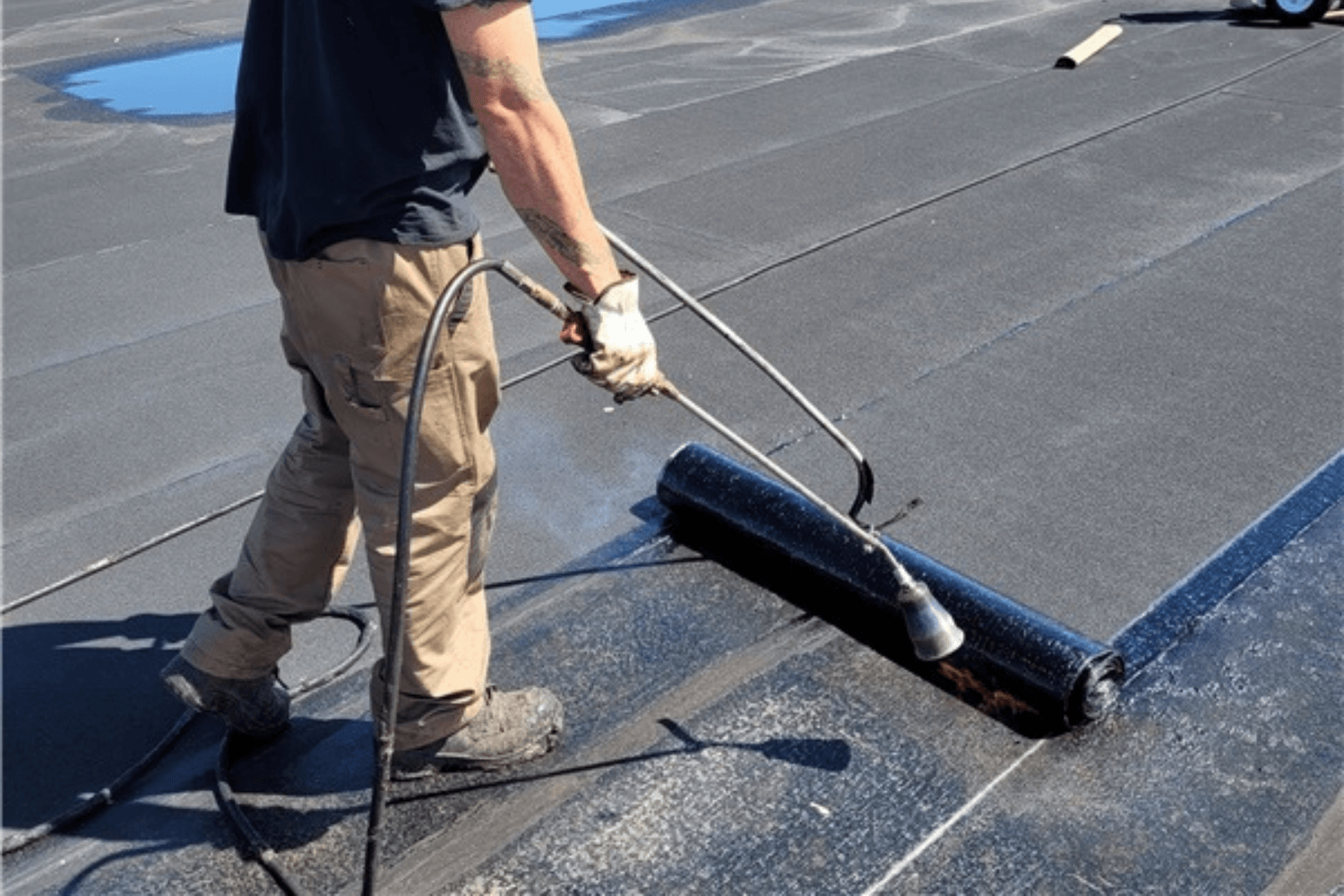
Downtown Wilmington and the historic riverfront commercial buildings require a different approach. Many of these structures are 80 to 120 years old, with masonry parapet walls, timber roof decks, and BUR or modified bitumen systems that were installed and sometimes re-installed over decades. The recover versus full tear-off decision on these buildings requires honest assessment — moisture scanning to determine insulation condition, evaluation of the deck structure beneath the existing system, and an understanding of the building's history. Trapping wet insulation under a new recover system on a historic downtown building is a failure mode we consistently see when the prior contractor skipped the investigation step.
Hurricane season shapes the Commercial Roofing calendar in Wilmington in ways that affect every category of work. Pre-hurricane season maintenance and inspection — ideally completed in April and May — is a recurring service need that every commercial property owner in this market should be scheduling annually. We look at perimeter flashings, coping caps, edge metal condition, drain clearance, and membrane integrity in the areas most vulnerable to wind uplift and sustained water infiltration. Buildings that arrive at June 1 with properly maintained flashings and cleared drainage systems consistently perform better through storm events than those with deferred maintenance. The cost of a pre-season maintenance visit is a small fraction of the cost of post-storm repairs and interior damage remediation.
Emergency dry-in and tarp operations after storm events are a core capability, not a sideline service. When a commercial building loses roofing in a hurricane, the priority is getting the building under temporary protection as quickly as possible to prevent ongoing water intrusion into the structure, interior finishes, equipment, and inventory. We deploy large-format commercial tarps on warehouse and industrial buildings and have the equipment and crew to cover significant roof areas rapidly. Temporary protection also establishes the condition at which the building arrived at the repair phase — documentation that matters for insurance claims when permanent repair work is subsequently scoped and priced.
Insurance claim documentation is a legitimate and recurring part of Commercial Roofing work in the Wilmington market. Owners who have experienced hurricane damage navigate the claims process regularly, and a roofing contractor who understands what adjusters need — detailed written damage assessments, pre-storm baseline documentation, clear photographic records of damage — is a genuine asset in that process. We work with commercial property owners and their insurance representatives throughout the claims process, from initial damage documentation through final repair completion.
Salt-air exposure deserves specific attention in any honest description of coastal Commercial Roofing. Aluminum edge metal, galvanized flashings, through-wall scuppers, pipe boots with metal clamp rings, and rooftop HVAC curb flashings all degrade faster in Wilmington's coastal environment than they would 100 miles inland. We specify materials with appropriate coatings and corrosion resistance for coastal exposure, and we pay particular attention to fastener selection — a stainless or corrosion-resistant fastener that will not corrode and lose grip in a coastal metal detail is not optional. It is the difference between a repair that holds through the next storm and one that fails in 18 months.
Commercial Roofing decisions are capital investment decisions. We give direct assessments — when a roof can be recovered, when it needs to come off, when a coating will extend its life, and when the most cost-effective answer is a full replacement with a system engineered for this climate. Our goal is not to sell the most expensive project; it is to give commercial property owners in Wilmington the honest information they need to make good decisions about buildings they own or manage in one of the most demanding Commercial Roofing environments on the East Coast.
Questions Owners Ask
What roofing system is best for a commercial building in Wilmington's coastal climate?
There is no single answer — the right system depends on building type, roof geometry, drainage configuration, exposure, and budget. For large low-slope industrial and warehouse buildings, TPO or EPDM membranes are common and effective. For coastal hospitality properties with steep or complex roof geometry, standing seam metal handles wind uplift and salt air better than any membrane system. For flat roofs with sound substrates, silicone coating systems extend life and add reflectivity. We assess each building individually and recommend the system that matches its specific conditions.
How does living near the coast affect how quickly my roof wears out?
Coastal exposure accelerates degradation of metal components — edge metal, flashings, fasteners, and pipe boots — through salt-air corrosion. UV intensity at coastal latitudes also degrades membrane surfacing and sealants faster than inland locations. Buildings within a mile of the ocean or sound see the most aggressive conditions. Buildings farther inland in New Hanover County still experience meaningful salt-air exposure, particularly during storm events that push marine air well inland. We specify materials with appropriate corrosion resistance for the exposure level of each property.
Do I need to do anything to my roof before hurricane season every year?
Yes. A pre-hurricane season inspection and maintenance visit — ideally completed in April or May — is the most cost-effective thing a commercial property owner in Wilmington can do to protect their building. We check perimeter flashings, drain clearance, membrane condition at seams and penetrations, and edge metal integrity. Correcting deficiencies before a storm is far less expensive than repairing them after one, particularly when interior damage from water intrusion is factored in.
My building took roof damage in Hurricane Florence. Can you still help even though that was several years ago?
Yes. Storm damage repair and restoration work continues for years after major events as owners address damage that was temporarily patched but never properly repaired, or as insurance claim settlements are finalized and permanent repair work is now funded. We assess post-storm roofs regardless of when the damage occurred and provide repair or replacement scopes based on current conditions.
Do you serve commercial buildings outside of Wilmington proper?
We serve commercial properties throughout the greater Wilmington metro area and surrounding region — New Hanover County, Brunswick County (Leland, Bolivia, Shallotte, Southport, Oak Island), Pender County (Hampstead, Burgaw, Surf City), and surrounding communities including Castle Hayne, Ogden, Rocky Point, and Wallace. The coastal weather patterns that define Commercial Roofing requirements in this market extend throughout the region.