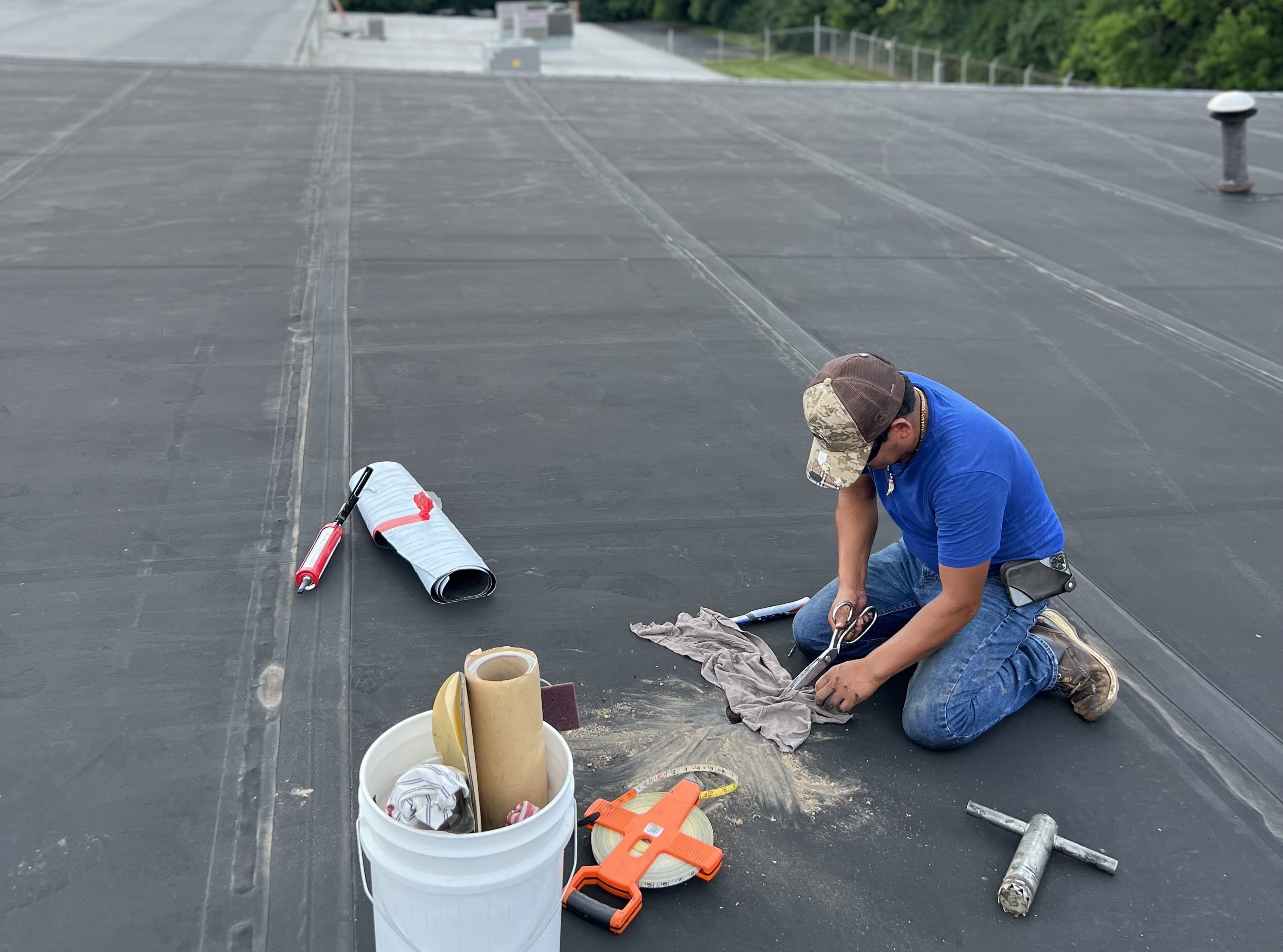
Wilmington's commercial corridors include the US-74 and US-17 commercial and industrial belts, the South Front Street and Cargo District redevelopment zones, the Wilmington International Airport area employment hub, and the Brunswick County suburban growth areas. Commercial roof preventive maintenance programs in this market protect warranty validity, provide the semi-annual inspection documentation that major manufacturers require, and generate capital planning forecasts that let property owners and facilities managers budget for roofing expenditures before an emergency forces the decision.
Commercial roof maintenance in Wilmington runs on a two-window calendar that does not exist in most inland markets. The pre-hurricane season window — April through May — is when every commercial property owner on the Cape Fear coast should be scheduling inspection and maintenance before the June 1 official start of Atlantic hurricane season. The post-storm window — October through November, after peak storm season has passed — is when deferred repairs, post-storm damage found during the season, and drainage system clearing should be addressed before winter. These two windows are not arbitrary suggestions. They are the logical response to a climate that delivers 60 inches of annual rainfall, a six-month hurricane season that has produced three significant storm events in the past decade, and a coastal environment that degrades roof components faster than inland markets. Commercial property owners who structure their maintenance program around these windows consistently see lower emergency repair costs and fewer post-storm insurance claims than those who manage reactively.
The pre-hurricane season maintenance visit covers the conditions that storm events exploit. Perimeter flashings — the base flashing at parapet walls, counterflashing at wall-to-roof transitions, and coping caps on parapet tops — are inspected and corrected where they show separation, corrosion, or improper lap. Edge metal and drip edge are checked for fastener condition and lap joint integrity, because wind uplift attacks loose edge metal first. All roof drains are cleared of debris and inspected for clamp ring tightness, drain body condition, and flow capacity. Overflow scuppers are verified to be open and unobstructed. Membrane seams and field areas are walked for evidence of lifting, blistering, or penetration flashing deterioration. Every penetration — pipe boots, HVAC curb flashings, conduit sleeves — is inspected individually. The result is a documented baseline of the roof's condition before storm season, with corrective work performed on any deficiencies found.
The post-storm season visit in October or November serves a different purpose. After six months of tropical weather, thunderstorm activity, and the rainfall that Wilmington's humid summers produce, there are almost always maintenance items that accumulated during the season — small membrane cuts from debris, flashing that worked loose during a tropical event, drain screens clogged with leaves and organic material, and sealant at penetrations that has cracked from the summer's thermal cycling. Identifying and addressing these items before winter prevents them from becoming larger failures during the December through March period when heavy rain events still occur even in the absence of tropical weather. The post-storm season visit also documents any storm damage that was identified during the season but deferred for permanent repair, and finalizes the scope for any insurance-related work that was temporarily protected during the storm season.
For commercial property owners managing multiple buildings across New Hanover and Brunswick counties, we offer portfolio maintenance contracts that schedule both service windows across all properties in a coordinated program. Portfolio contracts provide a fixed annual cost for planned maintenance rather than unpredictable repair bills, and they ensure that all properties in the portfolio receive consistent attention before and after storm season. We maintain detailed records for each building in the portfolio — inspection reports, repair history, photographs — so that condition trends are visible across the portfolio and capital planning for major replacements can be done with accurate data rather than guesswork.
Preventive maintenance economics in the Wilmington commercial roofing market are straightforward. The industry average return on commercial roof maintenance investment is commonly cited as 8 to 10 dollars in avoided repair cost for every dollar spent on planned maintenance. In a hurricane-exposed market like Wilmington, that ratio is likely higher — because the consequence of an unaddressed flashing failure or blocked drain is not just a local repair, it is the potential for a sustained rainfall event to turn a small deficiency into a major interior damage event. We have assessed buildings after Florence and Dorian where a $500 flashing repair that was identified on a prior inspection but not completed had allowed water infiltration that caused $50,000 to $100,000 in interior damage during the storm. That is not a hypothetical scenario — it is a recurring pattern in this market.
Drain maintenance deserves specific attention in Wilmington's rainfall environment. Commercial roof drains accumulate debris — leaves, organic material, bird nesting material, wind-blown grit — at a rate that varies by season and by the building's location relative to tree canopy and foot traffic. A drain that is clear in May may be partially obstructed by September after a summer of debris accumulation. We clear and inspect all roof drains at every maintenance visit, and on buildings with heavy debris loads we recommend mid-season drain clearance — particularly before forecast heavy rain events during tropical systems. A blocked drain during a tropical storm that delivers two to three inches per hour is a structural loading event waiting to happen, and the cost of a mid-season drain service is trivial compared to that outcome.
HVAC contractor coordination is a maintenance topic that building managers sometimes overlook. HVAC service technicians who access the roof regularly for equipment maintenance are a consistent source of incidental roof damage — pipe boots displaced, termination bars stepped on, membrane punctured by dropped tools, and gaps in flashing left unsealed after equipment service. We recommend that commercial building managers establish a protocol for their HVAC contractors: report any roof access to the facilities manager, avoid stepping on membrane outside the designated walk path if walk pads are present, and immediately report any contact with roofing components during service. We also recommend including a roof-condition walk after each HVAC service visit in the building's maintenance schedule — or folding it into the semi-annual maintenance visits we perform.
Sealant maintenance at penetrations is a recurring item on every maintenance visit. The sealants at pipe boots, conduit penetrations, and equipment curb flashings are subject to UV degradation, thermal cycling, and the mechanical movement of rooftop equipment that causes them to crack and separate over time. In Wilmington's coastal UV environment, sealant lifespans are shorter than inland markets — a sealant installed in good condition may show cracking at five to seven years rather than the 10-year lifespan it might achieve in a less UV-intensive environment. Replacing cracked sealants with appropriate materials before they open to water infiltration is one of the simplest and most cost-effective maintenance actions available.
We provide written maintenance reports after every service visit — condition photographs, items addressed, items flagged for future attention, and year-over-year condition comparison for properties we have maintained over multiple cycles. These reports are the basis for capital planning conversations with commercial property owners who are deciding when to invest in a major roof system replacement. A building with five years of maintenance records showing stable, well-maintained condition is in a fundamentally different position than one with no maintenance history when it comes to making that replacement timing decision — and the maintenance records also serve as documentation that the building was properly cared for if a storm damage claim is ever filed.
Questions Owners Ask
How much does a commercial roof maintenance program cost annually?
Annual maintenance contract pricing for commercial buildings in the Wilmington market varies by roof size, system type, and the number of service visits included. For a single commercial building with 10,000 to 25,000 square feet of roof area, annual maintenance programs covering two service visits typically range from $800 to $2,500 depending on scope and roof complexity. Larger buildings and portfolio contracts are priced based on total roof area and the specific scope of services included. We provide detailed proposals after an initial assessment of the building.
My building's roof was just replaced two years ago. Does it still need a maintenance program?
Yes — and in fact, the first few years after a new roof installation are important for identifying any installation deficiencies before they become significant failures, and for verifying that drainage is functioning as designed under actual rainfall conditions. Most commercial roofing manufacturer warranties include a maintenance requirement — allowing the roof to go unmaintained can void the warranty. And in Wilmington's storm-active market, even a two-year-old roof can sustain debris impact damage, drain obstruction, or minor flashing issues from a tropical event that should be addressed before the next season.
What is included in a pre-hurricane season maintenance visit?
A full pre-hurricane maintenance visit includes: inspection and repair of all perimeter flashings and edge metal, clearing and inspection of all roof drains and overflow scuppers, membrane seam and field inspection, individual inspection of all penetration flashings including pipe boots and HVAC curb flashings, coping cap and counterflashing inspection, and documentation of conditions found with photographs. Minor corrective work — sealant application, small flashing repairs, drain cleaning — is included in the service. Larger repairs identified during the visit are documented and priced separately.
Can you maintain roofs on buildings throughout Brunswick and Pender counties, not just Wilmington?
Yes. We maintain commercial roofs throughout New Hanover County, Brunswick County (including Leland, Bolivia, Southport, Oak Island, Shallotte, and surrounding communities), and Pender County (including Hampstead, Burgaw, and Surf City). Portfolio owners with buildings spread across the greater Wilmington region can include all properties in a single maintenance contract with coordinated scheduling.
What happens if my roof develops a problem between scheduled maintenance visits?
Maintenance contract clients receive priority scheduling for service calls that arise between scheduled visits. If an active leak or post-storm emergency requires immediate attention, we treat maintenance contract clients as priority dispatch. For non-emergency issues identified between visits, we schedule repairs promptly and document them as part of the ongoing maintenance record for the building. The goal of the maintenance program is to prevent between-visit emergencies — but when they occur, maintenance clients are not waiting in the same queue as new callers with no prior relationship.