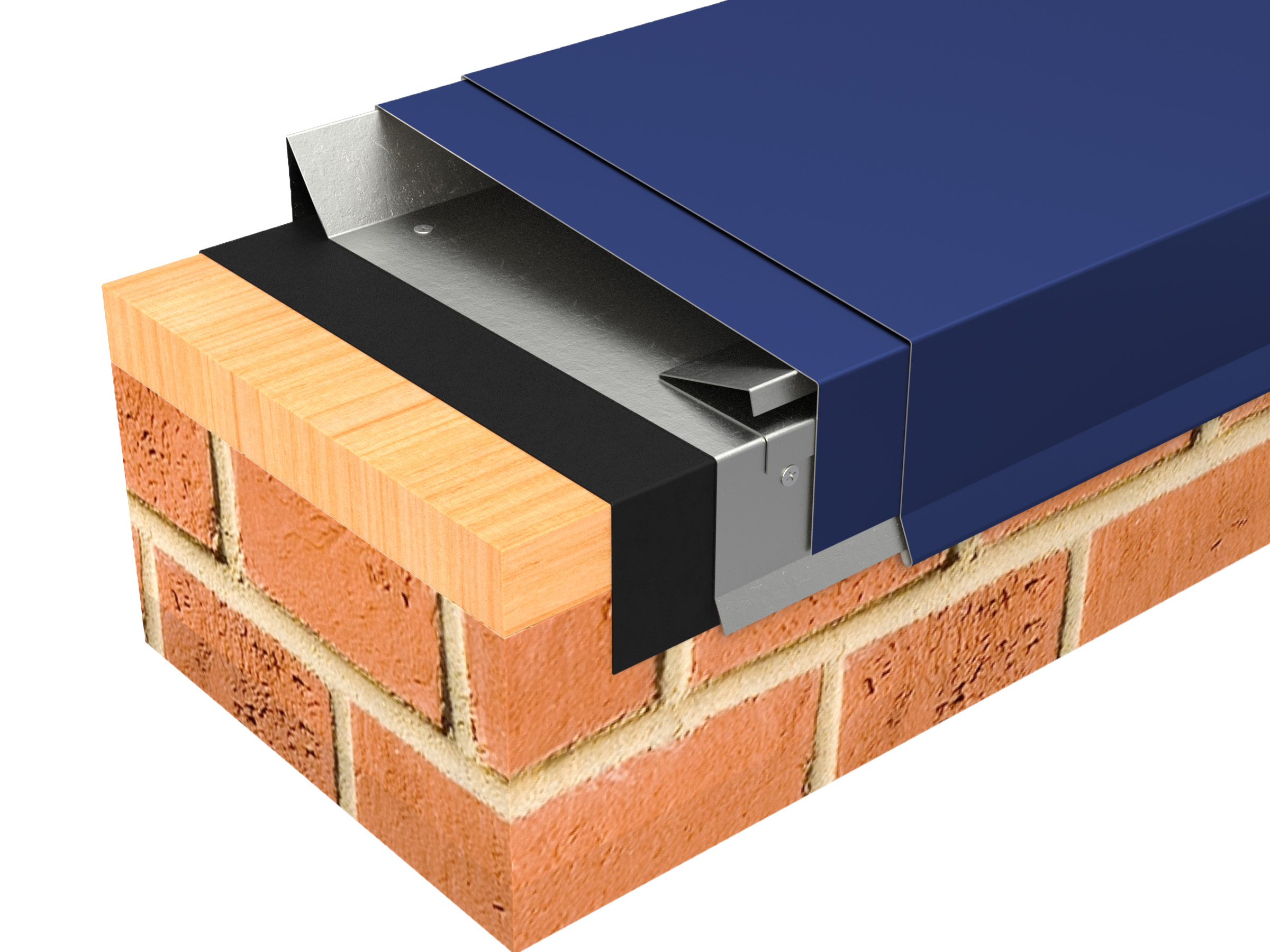
Edge metal, coping, and gutters are the components that define where your roof system ends and the rest of the building begins. In most inland commercial roofing markets, these details are important but not urgent. In Wilmington, they are a primary maintenance concern. Salt air from the Atlantic and the Cape Fear estuary attacks unprotected aluminum and galvanized steel edge components at a rate that surprises owners who have managed commercial buildings in inland markets. What takes 15 to 20 years to corrode in Raleigh or Charlotte can deteriorate to the point of failure in 5 to 8 years on a building within a mile of the water, and even buildings well inland in New Hanover County see accelerated metal degradation compared to non-coastal locations.
Aluminum edge metal and gravel stops are the most commonly specified components on commercial flat roofs, and they are particularly susceptible to the galvanic and salt-air corrosion that Wilmington's coastal environment accelerates. The issue is not just surface oxidation — it is corrosion at the fastener points, where dissimilar metals in contact with each other and with moisture create the conditions for rapid deterioration. A corroded screw holding an aluminum drip edge to a wood nailer provides significantly less uplift resistance than its rated value. Under the sustained negative pressure that a Category 1 hurricane generates at roof perimeters, that difference is the margin between edge metal that stays in place and edge metal that peels back and takes sections of membrane with it. We specify stainless steel or hot-dipped galvanized fasteners appropriate for coastal exposure on every edge metal installation, and we examine fastener condition closely during every inspection.
Coping caps on parapet walls are both a roofing component and an architectural feature, and in Wilmington's Historic Downtown district and along the Riverfront commercial buildings, they are often original masonry or sheet metal installations that have been in place for decades. Brick and cast stone coping on older downtown buildings develops mortar joint failures that allow water into the parapet wall assembly — water that can migrate down into the building or back under the roof membrane at the base of the parapet. Sheet metal coping on commercial buildings corrodes at the laps and at the cleats that hold it to the wall, and once those connections fail, the coping begins to lift in wind events. We replace deteriorated coping with properly sized, correctly lapped, and mechanically cleat-attached systems using materials with appropriate coastal exposure ratings. On historic masonry buildings, we coordinate with the building owner on material choices that are compatible with the building's character.
Gutters on commercial buildings in the Wilmington market need to be sized for rainfall intensities that most gutter systems are not designed to handle. The standard residential-grade K-style gutter that appears on some smaller commercial buildings in Wilmington is simply inadequate for a market that receives 60.15 inches of annual precipitation, much of it arriving in intense coastal storm events. A tropical storm that drops two inches per hour for six hours tests commercial gutter capacity in ways that normal rain events do not. We size commercial gutters using drainage calculations based on roof area and rainfall intensity for the Wilmington area's design storm events — not rules of thumb developed for inland markets with lighter precipitation loads.
Downspout sizing and placement are equally important. A correctly sized gutter connected to an undersized or improperly located downspout backs up under peak flow, overflows at the fascia, and directs water into wall assemblies and foundations. On large commercial buildings with expansive roof areas draining to gutters, we calculate the required downspout capacity and verify that the discharge point directs water away from the building foundation effectively. For buildings in Wilmington's lower-lying areas — parts of downtown, areas near the Cape Fear River — discharge point planning also accounts for the fact that heavy rainfall events can saturate ground at the building perimeter, requiring extended downspout extensions or underground piping to a drywell or storm drain connection.
Through-wall scuppers are the primary overflow device on commercial parapeted buildings, and their condition is a critical inspection point in Wilmington's pre-hurricane season review. Scuppers that have been sealed over with roofing material, corroded shut, or undersized for the roof area they serve are a structural risk during heavy rainfall events. We have seen Wilmington commercial buildings with blocked overflow scuppers that allowed ponding to reach depths that created dangerous live loads on the roof structure during Florence's extended rainfall. Scupper inspection, cleaning, and replacement where deteriorated is a standard part of our edge metal work on parapeted buildings.
Material selection for edge metal and coping in Wilmington's coastal environment is more nuanced than simply specifying the standard products in a manufacturer's catalog. Kynar-coated aluminum coping outperforms standard painted aluminum in coastal exposure. Copper is an excellent choice for historic downtown buildings where its appearance is appropriate — it is inherently corrosion-resistant and will develop a patina that protects the base metal indefinitely. Stainless steel is the most durable option for high-exposure coastal applications, though its cost reflects that performance. We discuss material options honestly with each client, presenting the cost-versus-longevity tradeoffs for the specific building location and budget.
Gutter maintenance is a service we perform on commercial contracts throughout New Hanover and Brunswick counties. The live oak canopy that characterizes many Wilmington commercial properties — particularly in older neighborhoods and campus settings — produces significant debris loads that can overwhelm gutters quickly. UNCW campus buildings and historic district commercial properties with mature tree coverage need gutter cleaning two to three times per year to maintain drainage function. We offer commercial gutter maintenance contracts that include scheduled cleaning visits with inspection of gutter condition, downspout clearance, and documentation of any deterioration that needs attention before the next storm season.
Every edge metal, coping, and gutter project we complete is photographed at each phase — removal of existing components, substrate and nailer condition, new installation, and completed terminations at the membrane. That documentation record is the baseline for future inspections and serves as evidence of installation quality for warranty purposes. In a market where hurricane wind events can challenge even well-installed edge metal, having clear documentation that the work was done correctly to manufacturer and code standards is a protection for both the building owner and our workmanship warranty.
Questions Owners Ask
How can I tell if my edge metal is corroding to the point where it needs replacement?
Signs include visible rust staining on the fascia below the drip edge, bubbling or lifting of paint on the edge metal surface, gaps opening at lap joints, and fastener heads that show corrosion or have backed out. At the flashing level, look for coping caps that rock or shift when pushed, and for mortar joint failures at the base of masonry coping. During our pre-hurricane inspection, we probe edge metal fasteners and check lap joint integrity specifically because these are the failure points that wind uplift exploits first.
What gutter size do I need for my commercial building in Wilmington?
Gutter sizing is calculated based on your roof's drainage area and the design rainfall intensity for the Wilmington area. For most commercial applications, 5-inch and 6-inch K-style or box gutters with appropriately sized downspouts are the minimum. On larger roof areas draining to a single gutter run, we may specify 7- or 8-inch commercial box gutters. We calculate required capacity for each project rather than applying a standard size — Wilmington's rainfall intensity during tropical events demands proper sizing, not guesswork.
My historic downtown building has original cast-stone coping that is deteriorating. Can it be restored?
Cast-stone coping can often be repaired rather than replaced if the deterioration is limited to surface scaling or minor joint failures. We assess the structural integrity of each coping unit and the mortar joints, and recommend repair where the stone is sound and replacement where units have fractured or where the joint failures are extensive enough that repair is not cost-effective. On historically significant buildings, we can work with the owner to source compatible replacement stone or cast-stone units where replacement is required.
Do overflow scuppers really matter that much on a flat commercial roof?
Yes — critically. They are the safety device that prevents a blocked primary drain from allowing water to accumulate to structural failure depths. During Hurricane Florence, several Wilmington commercial buildings experienced significant ponding because primary drains were overwhelmed and overflow protection was inadequate or obstructed. The weight of water on a roof accumulates quickly — one inch of water over 10,000 square feet weighs approximately 52,000 pounds. Overflow scuppers sized and positioned correctly prevent that loading from reaching dangerous levels.
How often should commercial gutters be cleaned on a Wilmington building?
At minimum, before hurricane season begins (April or May) and after the peak fall leaf drop (November or December). Buildings under heavy tree canopy — particularly live oak — need cleaning three to four times per year. Clogged gutters during a tropical rainfall event overflow at the fascia, which drives water into wall assemblies and can cause significant interior damage. Gutter maintenance is one of the least expensive preventive measures available and one of the most reliably cost-effective.