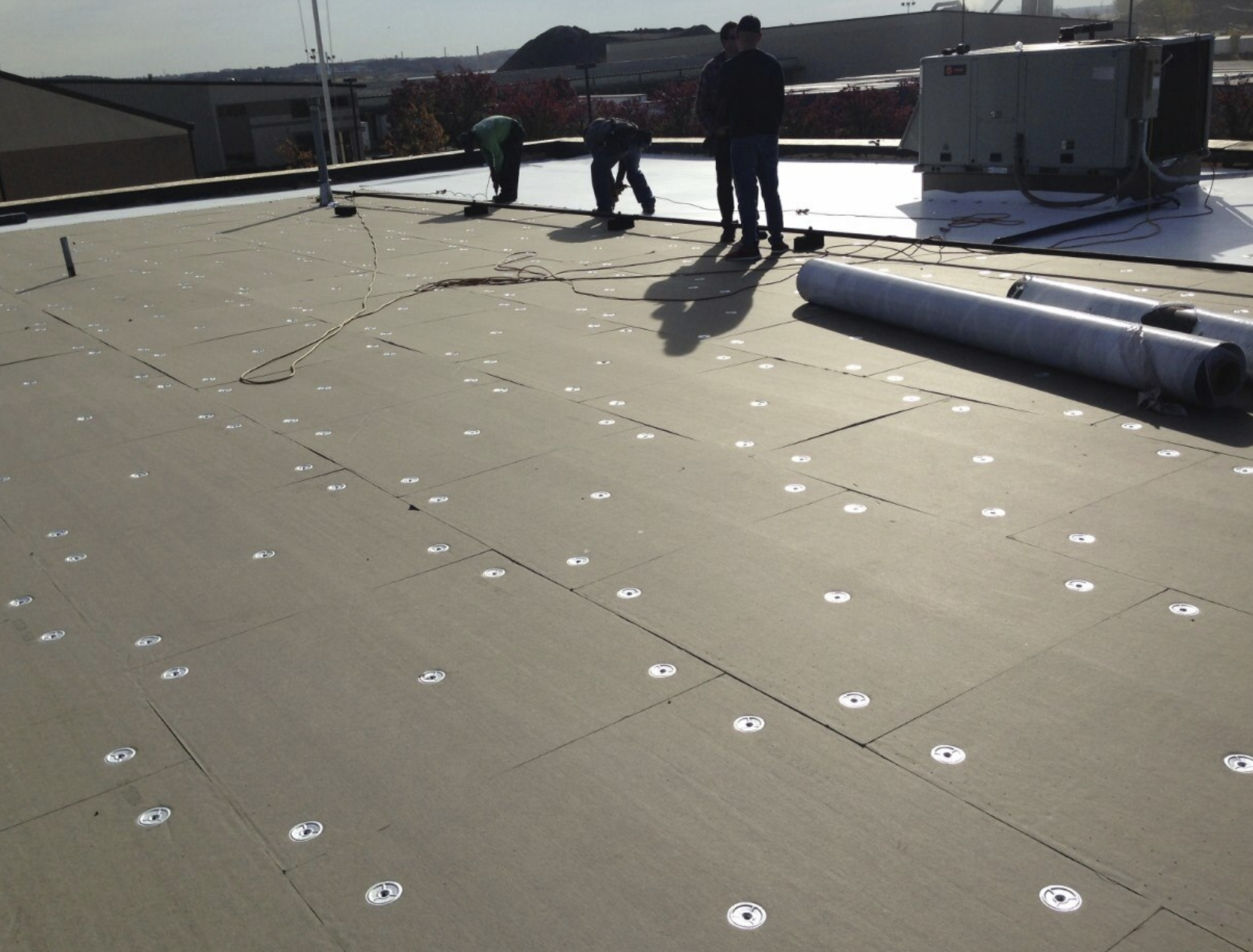
Wet insulation is the hidden cost driver behind more commercial roofing decisions in Wilmington than any other single factor. With 60.15 inches of annual rainfall and a hurricane season that can deliver 20 to 30 inches in a single multi-day event, the insulation layer beneath a commercial roof membrane is under sustained moisture pressure whenever the system above it has any compromised seam, flashing failure, or penetration gap. The problem is that wet insulation is largely invisible from the surface. A commercial property owner can walk a roof that looks reasonably intact — no obvious tears, no standing water — and have no idea that the polyisocyanurate or expanded polystyrene insulation beneath the membrane has been absorbing moisture for years through a failed termination bar or a slowly failing seam. That moisture is destroying the insulation's thermal performance, degrading the adhesion between the insulation and the deck, and in some cases beginning to affect the structural decking beneath.
Infrared thermal scanning is the diagnostic tool we use to assess insulation moisture condition before making any recover or restoration recommendation. Wet insulation retains heat differently than dry insulation — it stays warmer longer as ambient temperatures drop in the evening, creating a thermal differential that a calibrated infrared camera can detect as distinct warm zones in the roof field. Scanning is most effective in the late afternoon or early evening after a sunny day has heated the roof surface, and conditions need to be correct — clear sky, low humidity, sufficient solar exposure during the day — for reliable results. When scanning conditions are good, infrared can reveal moisture patterns in the insulation layer with a precision that no surface inspection can match. We use scanning results to create moisture maps of the roof field, identifying which zones have wet insulation and which are dry.
Core sampling validates the infrared findings and provides physical evidence of insulation moisture condition. We cut small-diameter cores through the membrane and insulation at locations identified by infrared scanning and at control locations in areas that appeared dry on the scan. The core sample reveals the actual moisture content of the insulation material at that location — we can compress a wet polyiso core and watch water express from it, or compare it to a dry core from a clean section of the roof. Core samples also reveal the number of existing insulation layers, the condition of the decking beneath the insulation, and whether the deck itself has been affected by moisture that has migrated through the insulation layer.
The recover decision hinges on two questions: how much of the insulation is wet, and is the deck sound? If moisture scanning shows that less than 25 percent of the roof area has wet insulation and the deck is in good structural condition, a recover — removing and replacing wet insulation sections while leaving dry sections in place, then installing new insulation and membrane over the assembly — is a viable option. It reduces disposal cost and disruption compared to a full tear-off. If wet insulation covers more than 25 percent of the roof area, or if the decking has deteriorated from prolonged moisture exposure, a full tear-off and replacement is the correct answer. Recovering over extensive wet insulation traps moisture in the assembly, accelerates new system failure, and produces a roof that never performs correctly regardless of the quality of the new membrane installed on top.
Recovery board — rigid board insulation installed over an existing membrane as part of a recover system — serves multiple purposes. It provides a new, flat substrate for the new membrane, it adds thermal insulation value to the assembly, and it compensates for minor surface irregularities in the existing membrane that would telegraph through a thin new single-ply membrane. For Wilmington commercial buildings undergoing a recover, we specify recovery board thickness and type based on the existing assembly's condition, the required R-value for code compliance, and the type of new membrane being installed over it. Polyisocyanurate (polyiso) is the most common recovery board in this market for its high R-value per inch of thickness, but it requires a cover board — typically a glass-mat gypsum or high-density polyiso — when a mechanically attached single-ply membrane is installed over it, to prevent fastener pullout through the softer polyiso face.
Insulation upgrades during roof replacement are the most cost-effective time to add thermal performance to a commercial building envelope. Tearing off an old roof system and installing new insulation at code-required or better R-values costs significantly less than adding insulation in a separate project. In North Carolina, commercial roof assemblies are subject to ASHRAE 90.1 energy code requirements that specify minimum R-values based on climate zone — Wilmington falls in Climate Zone 3, which has specific insulation requirements for low-slope commercial roofs. We verify code compliance in every new insulation specification and recommend exceeding the minimum when the incremental cost is justified by the energy savings, particularly on buildings with high cooling loads in Wilmington's hot, humid summers.
Tapered insulation systems address the drainage problems that are common on older Wilmington commercial buildings with flat roof decks that were not designed with adequate slope. A truly flat roof — zero slope — allows water to pond indefinitely after each rain event. In a market that receives 60 inches of annual rainfall, that ponding condition continuously stresses the membrane and promotes the biological growth and UV shielding that degrades reflective roofing surfaces. Tapered polyiso insulation, installed in a pattern that creates positive slope to drains or scuppers, solves the drainage problem permanently as part of the roof replacement project. We design tapered insulation layouts for Wilmington commercial buildings that eliminate ponding conditions and improve drainage to existing drain locations, or that redirect drainage to new drain locations if existing drain placement is inadequate.
Post-hurricane insulation assessment is a recurring service need in Wilmington. A major storm event that breaches a commercial roof — even temporarily — can drive significant amounts of water into the insulation layer in a short period. A building that is tarped and protected within 24 hours of hurricane damage may still have wet insulation from the water that entered before protection was installed. We assess insulation condition as part of every post-hurricane damage evaluation and factor wet insulation replacement into the permanent repair scope. Insurance claims for hurricane damage should include wet insulation replacement when scanning and core sampling confirm moisture in the assembly — it is a legitimate and significant component of the total damage.
Disposal of wet or saturated insulation from commercial tear-off projects is a logistics factor in Wilmington's coastal market. Polyiso and EPS insulation that has absorbed significant moisture is substantially heavier than dry material and cannot be recycled through standard insulation recycling programs in its wet state. We plan disposal logistics for each tear-off project, calculating dumpster capacity for the actual weight of the removed material rather than the theoretical dry weight, and coordinating with local disposal facilities for wet insulation that cannot be diverted from landfill.
Questions Owners Ask
How do I know if my commercial roof's insulation is wet without tearing the roof apart?
Infrared thermal scanning is the most reliable non-destructive method. We scan the roof under appropriate conditions — late afternoon after a sunny day — and identify thermal anomalies that indicate wet insulation beneath the membrane. Core sampling at identified locations provides physical confirmation. The combination of infrared mapping and selective core sampling gives us an accurate picture of insulation moisture distribution across the entire roof without tearing off the membrane everywhere.
Can I recover my roof instead of doing a full tear-off if some insulation is wet?
Sometimes. If moisture scanning shows that less than roughly 25 percent of the roof area has wet insulation and the deck is sound, selectively removing and replacing the wet zones and then recovering the entire roof is viable. If wet insulation is more widespread, or if the deck has deteriorated from moisture exposure, a full tear-off is the right answer. We present the data from our assessment honestly and explain the tradeoffs — a lower-cost recover that performs well versus a more expensive tear-off that is truly the correct solution for the building's condition.
What type of insulation is best for a commercial roof replacement in Wilmington?
Polyisocyanurate (polyiso) is the most widely specified commercial roof insulation in this market for its high R-value per inch of thickness. In Wilmington's hot climate, polyiso performs well for cooling load reduction. For buildings where the highest possible R-value in limited thickness is a priority, polyiso at appropriate thickness is the right choice. For applications where moisture resistance is a primary concern — particularly in areas with chronic drainage issues — EPS (expanded polystyrene) is more dimensionally stable when wet and does not face the R-value performance reduction at low temperatures that polyiso experiences in cold weather (less relevant in Wilmington's mild winters).
Should I add more insulation when I replace my commercial roof?
Yes, if the current assembly does not meet current energy code requirements or if adding insulation is cost-effective given the building's energy profile. The incremental cost of adding insulation thickness during a roof tear-off and replacement is modest compared to the cost of a separate insulation project, and the payback from reduced cooling energy costs in Wilmington's hot summers can be significant over the life of the new roof system. We calculate the energy code requirement for your building and present upgrade options with cost and estimated energy savings for each level of insulation increase.
My roof leaked during Hurricane Florence. Could my insulation be wet even though the roof has been repaired since then?
Yes, absolutely. Water that entered through a storm breach before temporary protection was installed can remain in the insulation assembly long after the surface has been repaired. Polyiso insulation, once wet, does not dry out readily under a membrane — the moisture is trapped. If your building had active water infiltration during Florence and the post-storm repair did not include insulation moisture assessment and replacement of wet sections, there is a meaningful chance that wet insulation is still present in the assembly, slowly degrading thermal performance and the adhesion of the repair membrane above it. An infrared scan will tell you definitively.