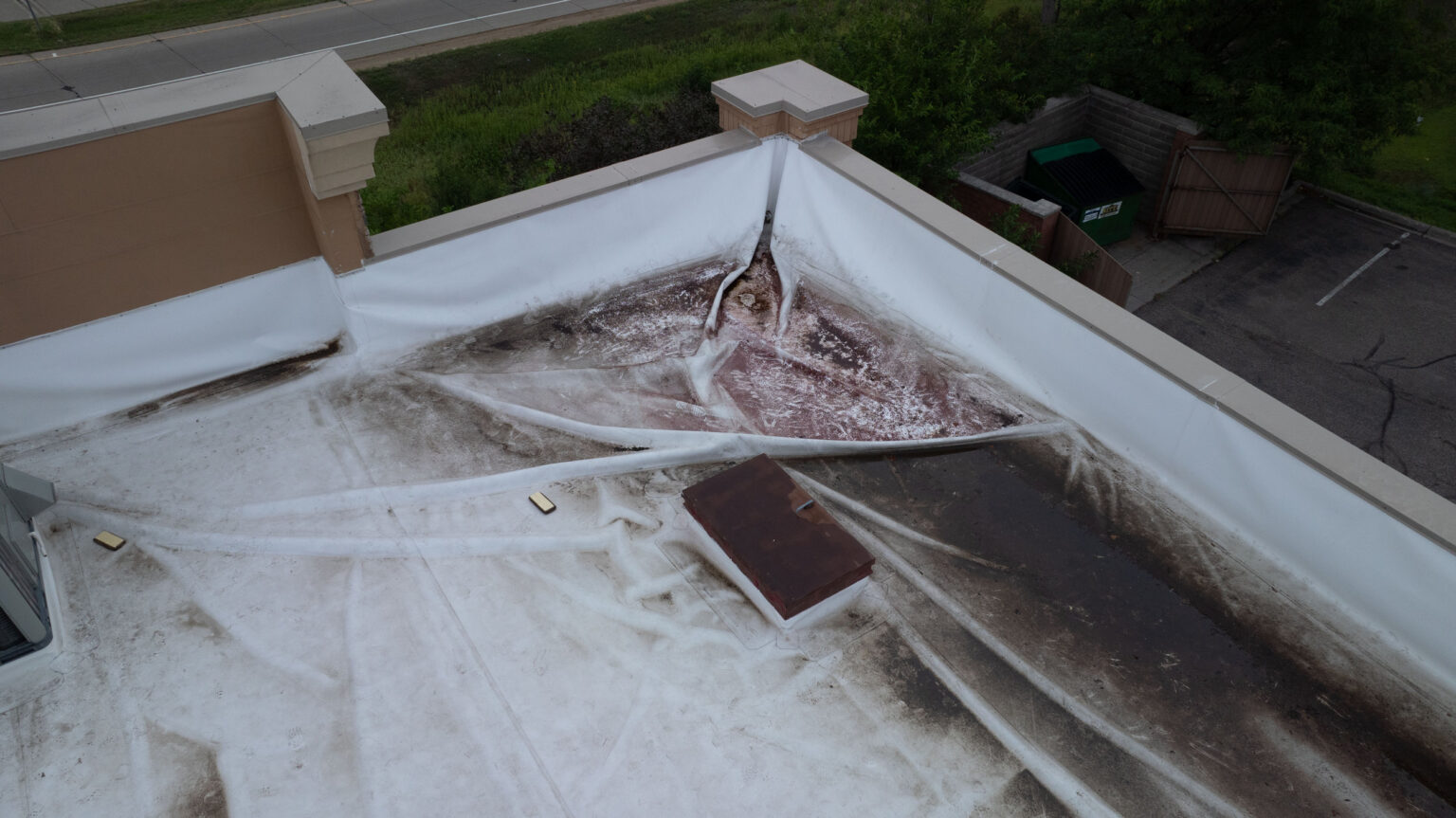
Commercial property owners in Wilmington, NC navigate hurricane insurance claims with a regularity that their counterparts in inland markets rarely experience. Florence in 2018, Matthew in 2016, Dorian in 2019 — each of these events generated hundreds of commercial property claims across New Hanover, Brunswick, and Pender counties. The claims process for commercial roofing damage is a distinct skill set, and a roofing contractor who understands it is a genuine asset to a building owner trying to recover the full value of a legitimate claim. We have worked through multiple storm cycles in this market and have developed the documentation practices, adjuster communication skills, and scope-writing discipline that the Wilmington commercial insurance claims process requires.
Pre-storm baseline documentation is the most underutilized tool available to commercial property owners in hurricane country. A dated, photographic inspection report completed before a storm creates an unambiguous record of the roof's pre-storm condition. When an adjuster reviews a post-storm claim, their job — and their carrier's financial interest — is to identify what is storm damage and what is pre-existing deterioration. Without a baseline, that determination is made entirely from post-storm observation, and adjusters sometimes attribute fresh storm damage to pre-existing wear or exclude damage as maintenance-related when the evidence is ambiguous. With a clear pre-storm baseline showing a roof in documented condition, the claim for damage that occurred during the storm is much stronger. We offer pre-hurricane season inspection specifically as a documentation service — the inspection report has roofing maintenance value, but its insurance documentation value alone justifies the cost for most commercial property owners in this market.
Post-storm evidence recording is time-sensitive. The optimal window for documenting hurricane roof damage is the first 24 to 72 hours after the storm passes and safe roof access is possible. During that window, the damage is in its original post-storm state — membrane that has been torn or displaced is still in the position the storm left it, debris impact points are fresh and distinguishable from pre-existing conditions, and water infiltration evidence in the interior reflects the storm event rather than subsequent weather. We respond to post-storm documentation calls as quickly as possible because we know that the quality of the insurance documentation diminishes as time passes, tarps are installed, and subsequent weather events complicate the picture.
Our post-storm documentation package includes photographic coverage of every damaged area with GPS-referenced roof mapping, written descriptions of each damage condition with dimensions and estimated quantities, notation of the mechanism of damage (wind uplift, debris impact, sustained rainfall infiltration), and a preliminary estimate of the permanent repair scope. We produce this documentation in a format that is useful to insurance adjusters — organized by roof section, clearly labeled, with close-up photographs of each failure mode alongside overview shots that establish the location context. Adjusters handling multiple commercial claims across a storm-affected region appreciate documentation that is clear and complete on first review rather than requiring follow-up requests for additional information.
Adjuster coordination is a service we actively provide. Many commercial property owners have limited experience with the insurance claims process and are uncertain about how to interact with an adjuster who arrives to inspect damage on a technical subject they do not have expertise in. We make ourselves available to walk the roof with the adjuster, explain the damage we have documented, answer technical questions about what caused each failure, and present our repair scope in the context of the observed damage. A roofing contractor who can explain clearly why a particular edge metal failure is a wind uplift failure rather than a corrosion failure, with the photographic evidence to support that characterization, helps the adjuster make an accurate determination rather than defaulting to a conservative exclusion.
Scope disputes between a property owner's contractor and an insurance adjuster are a common friction point in commercial hurricane claims. Adjusters working from desktop review of photographs sometimes develop scopes that are narrower than the actual damage warrants — patching where replacement is required, or excluding wet insulation that infrared scanning would confirm is damaged. When we believe that an adjuster's proposed scope undervalues legitimate storm damage, we provide a written supplement to the claim with additional technical documentation explaining why our scope is correct. We have successfully supplemented commercial claims to recover additional scope in multiple post-storm cycles in the Wilmington market, and we approach those conversations professionally and with documentation rather than confrontationally.
Public adjusters and attorneys sometimes become involved in complex commercial hurricane claims. We work with whichever representatives the property owner has retained and provide technical roofing documentation to support the claim process regardless of how the owner has chosen to manage their claim. Our role is to document the roofing damage accurately and completely, provide honest repair scoping, and execute the repair work correctly — not to advocate beyond our technical expertise. Property owners who are uncertain about whether to retain a public adjuster for a complex commercial claim should evaluate that decision with their insurance broker and legal counsel; we can provide technical documentation to support whatever process the owner chooses.
Commercial flood insurance — separate from wind and hail coverage under standard commercial property policies — is a consideration for Wilmington commercial buildings in flood-prone areas. Hurricane Florence caused catastrophic flooding in parts of New Hanover and Brunswick counties from storm surge and river overflow, and some of the commercial building damage in those areas involved both roof damage (covered under wind/hail provisions) and interior flood damage (covered only under separate flood policies). The documentation and claims process for flood damage overlaps with but is distinct from the roof damage claim process. We focus on the roofing component — the wind and water infiltration damage at the roof level — and document clearly what damage is attributable to roof failure versus what is flood damage from below.
For commercial property owners who have not yet filed a claim for Florence, Matthew, or Dorian damage — or who received a claim settlement they believe undervalued their damage — statute of limitations and policy notification requirements vary. We recommend consulting with an insurance attorney or public adjuster regarding any late-filed or disputed claims from prior storm events. What we can provide is current-condition documentation and assessment of whether ongoing damage from an original storm event can still be identified and quantified, which may be relevant to a claim that was filed but not fully resolved.
Questions Owners Ask
When should I get a pre-storm inspection for insurance documentation purposes?
April or early May — before hurricane season begins June 1 — is the ideal timing. The inspection establishes a clear baseline of your roof's condition before any storm event. If a storm causes damage later in the season, the dated pre-storm inspection report demonstrates what the roof looked like before the event, which directly supports the damage claim. We also recommend keeping prior inspection reports on file — a multi-year documentation trail showing a well-maintained roof is the strongest possible baseline for a major claim.
Do I need to wait for the insurance adjuster before making temporary repairs?
No — and you should not wait if the building is sustaining ongoing damage from active water infiltration. Commercial property policies typically require you to take reasonable steps to prevent further damage, and emergency tarping and temporary patching qualify. The key is documenting the original damage condition with photographs before any protective work is installed. We photograph all damage before beginning any temporary protective measures, preserving the evidence the adjuster needs while stopping the ongoing damage.
What if the insurance adjuster's scope is less than what my roof actually needs?
You have the right to dispute an adjuster's scope with documentation supporting the broader claim. We provide written supplements to insurance scopes when we believe the adjuster's determination undervalues legitimate storm damage — with technical explanation and photographic evidence for each disputed line item. Successful supplemental claims are common in complex commercial hurricane damage situations where the original adjuster scope was developed from desktop review rather than on-site technical assessment.
Does my insurance cover wet insulation that resulted from hurricane damage?
Yes, insulation damaged by storm water infiltration through a storm-caused roof breach is part of the storm damage claim. The key is documenting the insulation condition — infrared scanning and core sampling that show wet insulation in areas consistent with the documented roof breach are the evidence that supports including insulation replacement in the claim scope. We include insulation moisture assessment as a standard part of post-hurricane damage documentation for exactly this reason.
We had storm damage in Florence but only got a partial repair done. Can we still file or supplement a claim?
That depends on your policy terms, notification requirements, and the statute of limitations in your state. North Carolina has specific rules governing insurance claim filing and dispute resolution timelines. We recommend consulting with your insurance broker or an insurance attorney about your options given the time elapsed. We can provide current-condition documentation and an assessment of what ongoing or unrepaired damage from the original event still exists, which may support a supplemental filing if your policy and timeline permit it.