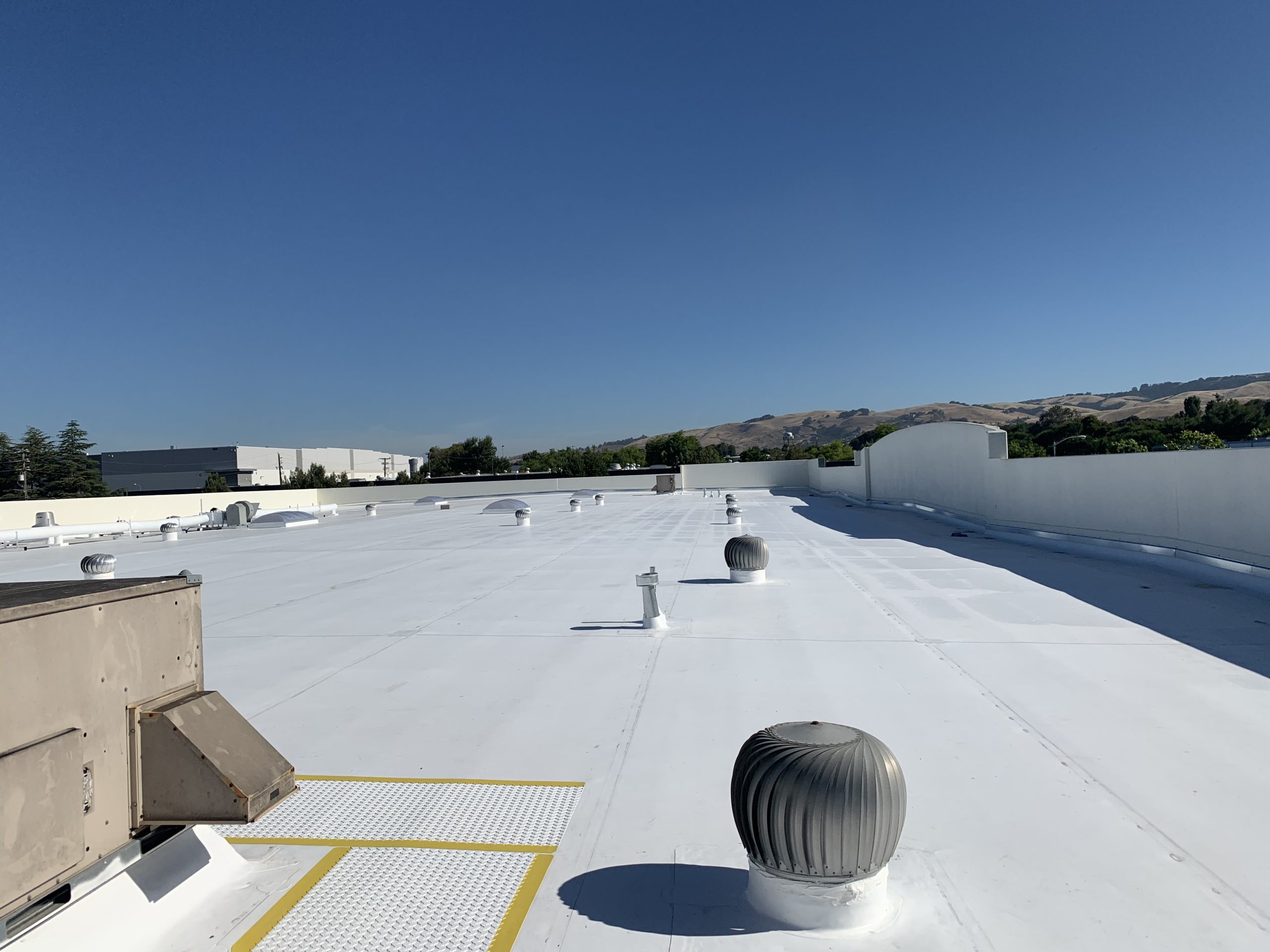
KEE — ketone ethylene ester — single-ply roofing membrane is the specification answer for commercial buildings where standard TPO or PVC is not sufficient for the chemical and thermal environment on the roof. In the Wilmington market, the primary application is industrial and logistics buildings where rooftop drainage carries chemical contaminants, where exhaust systems deposit petroleum-based materials on the membrane surface, or where the combination of high UV exposure and coastal temperature cycling degrades standard single-ply membranes faster than their rated service life. Port of Wilmington logistics facilities, ILM Business Park industrial tenants, and manufacturing operations in Northchase and Pender Commerce Park are the building types where KEE membrane's specific performance characteristics justify its premium over standard TPO.
The chemistry distinction between KEE and standard TPO matters in industrial applications. Standard TPO membrane contains plasticizers that can migrate out of the membrane over time, particularly under sustained UV exposure and thermal cycling — a phenomenon that causes TPO to become brittle at the surface, develop micro-cracking at seams, and lose the flexibility needed to accommodate structural movement. KEE membrane uses a different polymer chemistry that does not rely on migrating plasticizers for flexibility — the ketone ethylene ester formulation maintains dimensional stability and flexibility throughout its service life without the plasticizer loss issue. In Wilmington's coastal environment, where UV intensity from the ocean reflection combines with high temperatures from June through September, plasticizer stability is a real performance differentiator, not a theoretical one.
Chemical resistance is the other defining characteristic of KEE membrane. Petroleum-based drips and spills from rooftop HVAC equipment, exhaust deposits from industrial processes, and drainage from rooftop surfaces that accumulate solvent-containing runoff can all degrade standard single-ply membranes over time. KEE's chemical resistance profile significantly exceeds standard TPO's, making it the appropriate specification for industrial roofs where chemical exposure is a foreseeable condition. We assess the specific chemical environment on the roof as part of the specification process — reviewing what equipment is present, what materials are processed or stored in the building, and what drainage conditions exist — before recommending KEE versus standard single-ply.
Installation of KEE membrane follows the same heat-welding process as standard TPO, which means that the seam integrity advantage of hot-air welded single-ply — fully fused seams that are as strong as the field membrane — applies to KEE systems as well. Seam quality is critical on Wilmington commercial roofs regardless of membrane type, because the sustained rainfall of tropical events tests seam integrity at intensities that normal rain events do not. We use the same seam quality control protocol on KEE installations as on standard TPO — temperature and speed verification on each welder, test welds at the start of each day, and seam probe testing of completed welds before the installation area is signed off.
ILM Business Park buildings present a specific application profile for KEE membrane consideration. The proximity to Wilmington International Airport creates rooftop environments with potential jet fuel exhaust deposits and the mechanical vibration from aircraft operations that can stress roof system adhesion at penetrations and perimeter details over time. Industrial tenants in the business park include operations with chemical process exhaust that vents to the roof. These conditions, combined with the coastal UV and salt-air exposure that affects all Wilmington commercial buildings, make KEE membrane's combined UV stability and chemical resistance a meaningful performance advantage over standard TPO or EPDM for buildings where those specific exposures apply.
KEE membrane is available in both mechanically attached and fully adhered installation configurations. For large industrial roofs where wind uplift resistance is a primary design parameter — Wilmington's hurricane exposure makes this relevant for every commercial building, but especially for large, flat-roofed warehouse and logistics facilities — fully adhered KEE provides the highest uplift resistance. Mechanical attachment provides a faster installation and allows for some deck movement without stressing the membrane, and is appropriate for buildings where the structural deck analysis supports it. We evaluate attachment method for each project based on the building's structural characteristics, uplift design requirements for the Wilmington wind zone, and manufacturer warranty requirements.
Warranty terms for KEE membrane systems typically extend to 20 years from major manufacturers when installed by certified applicators and registered with the manufacturer at project completion. We maintain KEE installation certifications and complete the manufacturer registration process on every warranted project. In a market where hurricane events can trigger warranty claims, having a valid, registered manufacturer warranty rather than a workmanship-only guarantee provides meaningful protection. Manufacturer warranties for commercial single-ply systems typically cover both material defects and installation deficiencies when the installation was performed by a certified contractor under manufacturer inspection — a higher standard than a standard contractor workmanship warranty.
Maintenance of KEE membrane in Wilmington's coastal environment follows the same general protocol as other single-ply systems but with specific attention to the areas where chemical resistance is being tested. Periodic inspection of the roof surface for evidence of chemical attack — discoloration, surface degradation, or softening near exhaust discharge points or equipment drip areas — allows us to identify whether the membrane's chemical resistance is being exceeded in specific locations before a failure develops. When we identify areas of concern, we document them, investigate the source of the chemical exposure, and determine whether the condition requires membrane replacement in that area or whether protective measures — drain guards, equipment maintenance — can resolve the exposure.
For building owners considering KEE membrane for a new project or replacement, the decision framework is straightforward: if your building has standard occupancy without chemical process exposure, and your primary concerns are UV stability and coastal durability, standard TPO with appropriate mil thickness is the right specification. If your building has identifiable chemical exposure conditions on the roof — industrial exhaust, petroleum equipment drips, solvent-containing drainage — or if you have had premature TPO degradation in specific locations that suggests chemical attack, KEE is the appropriate upgrade. We will tell you honestly which situation your building presents.
Questions Owners Ask
What is the difference between KEE and TPO roofing membranes?
Both are thermoplastic single-ply membranes installed with heat-welded seams, but they use different polymer chemistries. TPO uses a polypropylene-based formulation with plasticizers that can migrate out over time under UV exposure, eventually causing brittleness and micro-cracking. KEE uses a ketone ethylene ester formulation that maintains flexibility without relying on plasticizer migration, providing better long-term UV stability. KEE also has significantly higher chemical resistance than standard TPO, making it appropriate for industrial applications with chemical exposure conditions.
Is KEE membrane worth the additional cost over standard TPO?
For standard commercial and industrial buildings without specific chemical exposure conditions, standard TPO from a reputable manufacturer installed at appropriate thickness is a well-proven system that does not need to be upgraded to KEE. For buildings with chemical process exhaust, petroleum equipment drips, or other identifiable chemical exposure on the rooftop environment, KEE's additional cost is justified by the performance difference. We assess your specific building conditions honestly and recommend KEE only when the building's exposure profile warrants it.
How does KEE perform in hurricane conditions compared to standard TPO?
KEE and standard TPO perform comparably in wind uplift resistance when installed using the same attachment method and fastener pattern. Both systems use heat-welded seams that provide equivalent seam strength. The hurricane performance differentiator is the attachment method — fully adhered versus mechanically attached — and the quality of perimeter and flashing details, not the membrane chemistry. KEE's advantage in storm conditions is its plasticizer stability, which means the membrane remains flexible after years of coastal UV exposure rather than becoming brittle — a condition that can lead to seam failure under sustained wind and rain loading.
We have a chemical process facility in the ILM Business Park. Is KEE the right membrane for our roof replacement?
It may be. We would want to assess the specific chemicals and concentrations present in your rooftop environment — exhaust discharge composition, equipment drip conditions, and drainage chemistry — before making a definitive recommendation. KEE's chemical resistance profile covers a broad range of common industrial chemicals, but no single membrane is resistant to all possible chemical exposures. We research the specific exposure conditions at your facility and match the membrane specification to those conditions rather than applying a generic recommendation.
Can KEE membrane be installed over an existing roof as a recover?
Yes, with the same qualification that applies to any recover: the existing insulation must be assessed for moisture content before the recover proceeds. We use infrared scanning and core sampling to verify insulation condition before recommending a recover over any existing system. If the insulation is dry and the existing membrane provides an adequate substrate, KEE can be installed over it with an appropriate recovery board. If insulation moisture is present, a full tear-off is required regardless of the membrane type being installed.