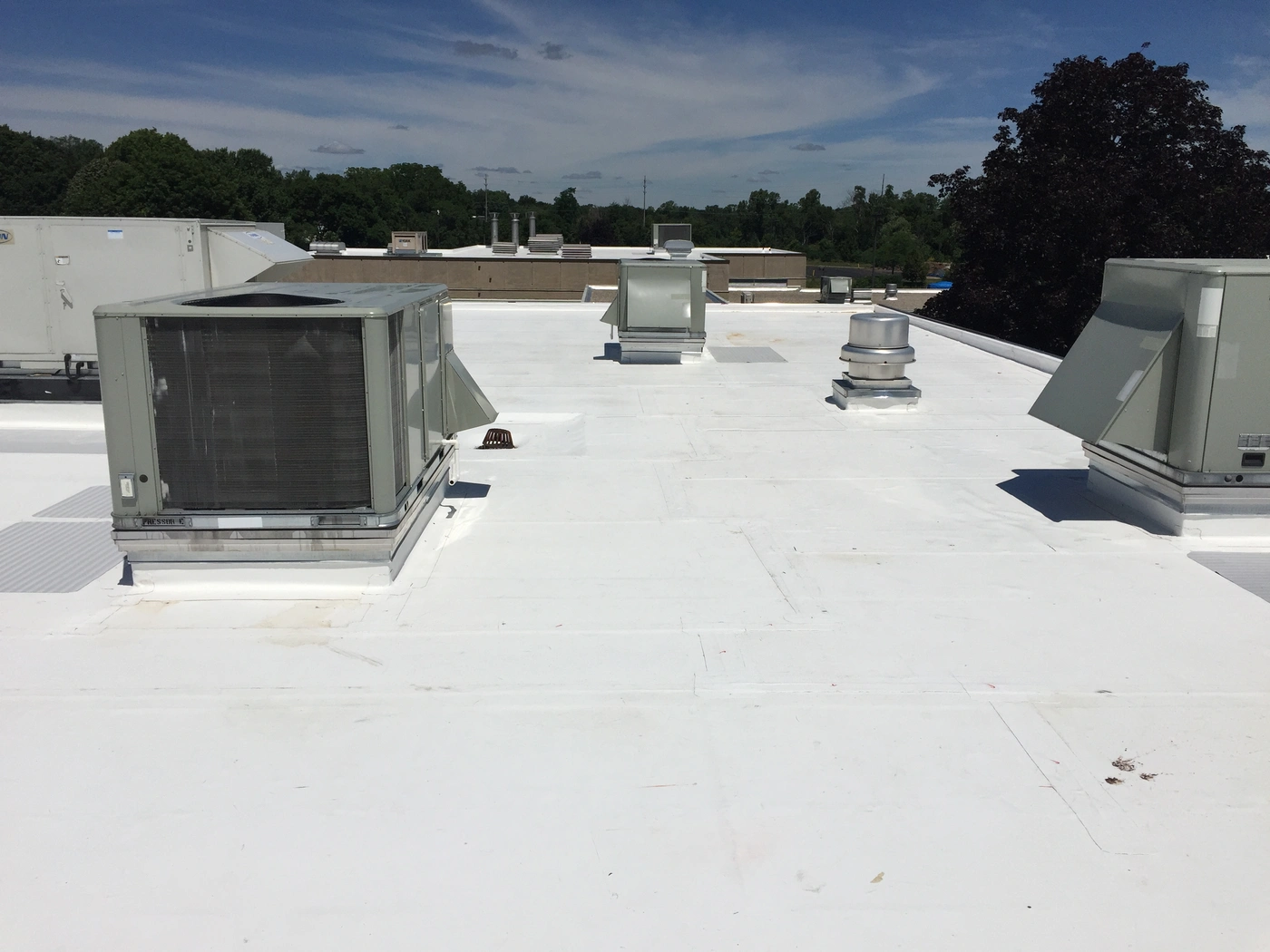
PVC Roofing membrane earns its place in the Wilmington commercial market through two specific performance characteristics that matter in this region: exceptional chemical resistance and outstanding heat-welded seam strength. For restaurant and food-service buildings along Military Cutoff Road, in the Mayfaire Town Center corridor, and on Oleander Drive's dense commercial strip, the grease resistance of PVC is the deciding factor in membrane selection. Kitchen exhaust systems on commercial roofs deposit aerosolized cooking oils onto the membrane surface, and those oils degrade standard TPO and EPDM membranes over time — softening the membrane, attacking seam adhesion, and accelerating UV oxidation in the contaminated areas. PVC's inherent resistance to animal fats, vegetable oils, and the petroleum-based grease trap chemicals used in food-service cleaning makes it the appropriate specification for any roof that receives kitchen exhaust discharge.
Mayfaire Town Center and the Military Cutoff Road commercial corridor represent Wilmington's most concentrated food-service and retail density. Multi-tenant buildings with mixed restaurant and retail occupancy in these areas often have complex rooftop equipment configurations — multiple HVAC units, kitchen exhaust fans, grease traps, and conduit runs — that create both chemical exposure challenges and penetration-density challenges. PVC membrane handles the chemical environment, but the penetration density requires careful flashing detail work. Every curb, pipe boot, and conduit penetration is a potential water entry point, and in Wilmington's tropical rainfall events, the number of penetrations on a food-service roof is directly proportional to the number of potential leak locations that need to be correctly detailed and maintained.
PVC's heat-welded seam system is among the strongest in the single-ply membrane category. A properly executed hot-air weld fuses the two PVC sheets into a single continuous layer at the seam — the weld is as strong as or stronger than the field membrane itself. This matters in Wilmington's storm environment because seam failures are a primary mode of single-ply membrane breach during sustained tropical rainfall. Water infiltrating a failed seam during a multi-day tropical event causes far more damage than the initial seam failure suggests — the water tracks laterally in the insulation layer well beyond the seam location, creating wet insulation damage in areas that appear dry from the surface. PVC's weld quality, combined with proper weld inspection during installation, produces seam integrity that holds under sustained rainfall pressure in a way that tape-bonded or adhesive-bonded seams cannot match.
Port of Wilmington industrial buildings and chemical-handling facilities in the Northchase and Pender Commerce Park corridors have a different PVC application profile than food-service buildings. These facilities may have rooftop drainage that contacts petroleum products, industrial solvents, or process chemicals from facility operations. PVC's resistance profile covers a broad range of industrial chemicals — it maintains membrane integrity under exposure conditions that would degrade standard TPO or EPDM membranes meaningfully. For building owners in industrial occupancies where rooftop chemical exposure is a foreseeable condition, PVC — or KEE membrane with comparable chemical resistance — is the appropriate specification. We assess the specific chemicals present at each facility and match the membrane specification to the actual exposure profile rather than applying a generic recommendation.
PVC membrane in Wilmington's coastal climate faces one significant long-term challenge: plasticizer migration. Like standard TPO, PVC contains plasticizers that maintain the membrane's flexibility — and those plasticizers can migrate out of the membrane over time under sustained UV exposure and thermal cycling, causing the membrane to become brittle and develop surface cracking. This is a known characteristic of standard PVC membrane and affects its long-term performance in high-UV coastal environments. The mitigation is selecting PVC products from manufacturers with formulations designed for UV-intensive applications, specifying appropriate membrane thickness for the application, and maintaining the roof surface to slow the UV degradation process. We discuss PVC formulation options with clients on projects where long-term coastal UV performance is a primary concern, including the option of KEE membrane as an alternative when plasticizer stability is the dominant performance requirement.
Installation quality on PVC projects follows the same rigorous seam quality control protocol we apply to all heat-welded single-ply systems. Welder temperature calibration at the start of each day, test weld verification before field welding begins, and seam probe testing of completed welds are standard practice. PVC welding is somewhat less forgiving than TPO welding in terms of temperature window — PVC welds at a lower temperature range and can be over-welded (burning through the membrane) more easily than TPO. Experienced applicators who work with PVC regularly produce consistently high-quality welds; those who primarily work with TPO and occasionally attempt PVC installations sometimes produce substandard seams. We apply PVC regularly and understand its installation requirements.
Roof drain and scupper specification on PVC roofs requires attention to material compatibility. Some drain bodies and clamping ring materials react with PVC membrane, causing degradation at the membrane-to-drain interface over time. We specify drain components that are chemically compatible with PVC membrane and verify compatibility at the design stage of each project. Stainless steel drain bodies and clamping rings are the standard specification for PVC roofs in the Wilmington market — they avoid compatibility issues and provide the corrosion resistance appropriate for a coastal environment where standard cast iron or galvanized drain bodies corrode faster than inland markets.
For restaurant and food-service building owners in Wilmington who have experienced repeated leaks at kitchen exhaust discharge points on a TPO or EPDM roof, PVC membrane replacement of the affected area — or full roof replacement in PVC — is the correct solution. Patching TPO or EPDM repeatedly at grease-contaminated areas is a losing proposition: the contamination continues to degrade the membrane and the surrounding patched areas after each repair. Converting the roof — or at minimum the areas around kitchen exhaust discharge — to PVC membrane eliminates the root cause of the recurring failure rather than repeatedly addressing the symptoms.
We maintain manufacturer certifications for PVC installation that allow us to offer warranted PVC Roofing systems with manufacturer-backed coverage. Warranty terms for commercial PVC systems range from 15 to 20 years from major manufacturers when installed by certified applicators on registered projects. Warranty registration documentation, including seam quality records and material lot numbers, is completed and submitted for every PVC project we install, and copies are provided to the building owner for their records.
Questions Owners Ask
Why does my restaurant roof keep leaking near the kitchen exhaust fan even after multiple repairs?
Grease and cooking oil deposited by the exhaust system are likely degrading the membrane around the exhaust discharge point. Standard TPO and EPDM membranes are not resistant to animal fats and cooking oils — the contamination softens the membrane and attacks seam adhesion, causing the area to fail repeatedly even after patching. The correct solution is replacing the membrane in the affected area — or the entire roof — with PVC or KEE membrane, which are chemically resistant to cooking grease. Patching a grease-contaminated TPO or EPDM roof will produce the same result again.
How does PVC compare to TPO for a standard commercial building without food service?
For standard commercial applications without chemical exposure, both PVC and TPO are effective single-ply membrane options with heat-welded seam systems and comparable warranty coverage. TPO is generally less expensive and more widely specified for standard commercial and industrial applications. PVC's premium is justified when chemical resistance is required. For buildings without that specific need, standard TPO in the appropriate thickness is the cost-effective recommendation and we will say so directly.
Does PVC Roofing hold up in hurricane conditions?
PVC with a fully adhered or mechanically attached base system and properly executed heat-welded seams performs well in hurricane wind and rain conditions. The heat-welded seam is among the strongest joint types in commercial single-ply roofing and holds up under sustained rainfall pressure effectively. Perimeter detailing — edge metal, flashings, and coping — is the critical variable in hurricane performance for any membrane type, including PVC. A well-installed PVC system with properly detailed perimeter conditions is a durable performer in Wilmington's storm environment.
Is PVC Roofing a cool roof option for energy savings in Wilmington's hot climate?
Yes. White PVC membrane achieves high initial reflectance values comparable to white TPO, qualifying for ENERGY STAR certification and providing the cool roof energy performance argument for reducing cooling loads in Wilmington's hot, humid summers. PVC maintains its white color well over time when the surface is kept clean, though biological growth in Wilmington's warm, humid conditions can reduce effective reflectance between cleanings. Periodic cleaning with appropriate biocidal agents restores reflectance and is a standard part of the maintenance program for any white single-ply system in this climate.
How long does an PVC roof last on a coastal commercial building?
A properly installed commercial PVC system with appropriate membrane thickness typically delivers 20 to 25 years of service life with regular maintenance. Plasticizer migration under sustained coastal UV exposure can cause premature brittleness at the membrane surface if a lower-quality formulation is specified or if the roof is neglected. Specifying products from manufacturers with UV-stable formulations, maintaining the roof on a regular schedule, and keeping the surface clean of biological growth that accelerates UV degradation are the key factors in achieving full service life from an PVC system in coastal Wilmington.